EU Allergen Labelling Requirements for Irish Food Businesses in 2026
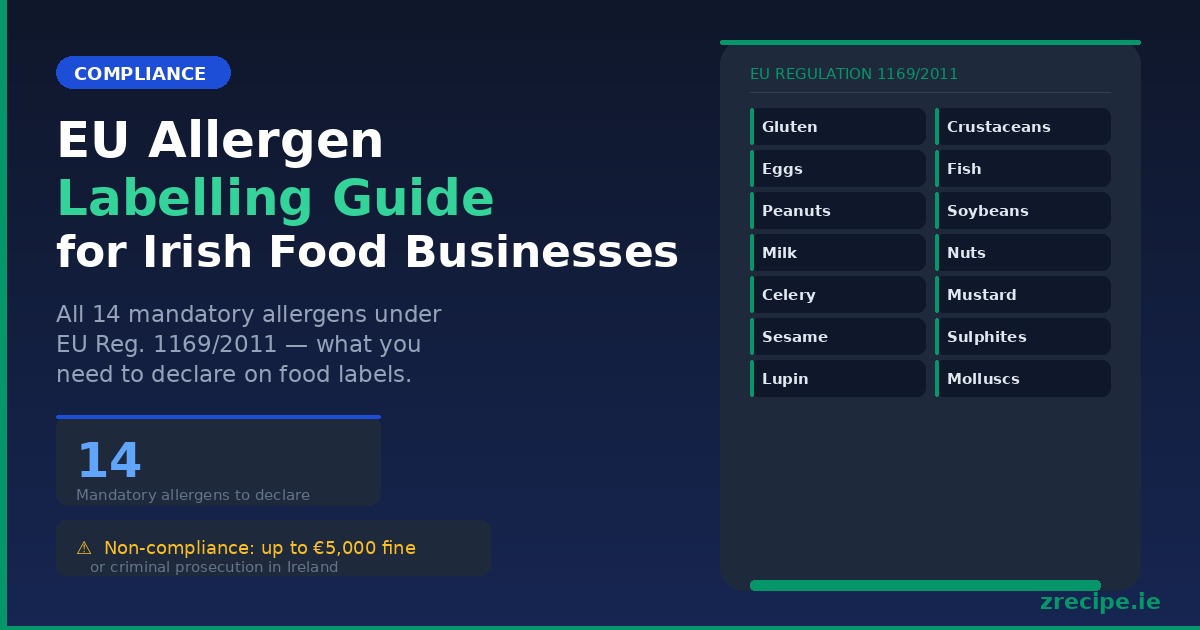
Allergen labelling isn't optional paperwork — it's a legal requirement for every food business trading in Ireland and the EU, and getting it wrong carries real risk for your customers and your business. Here's what you actually need to know.
What is EU Regulation 1169/2011?
EU Regulation 1169/2011 on Food Information to Consumers is the law that requires food businesses to clearly declare any of 14 specified allergens present in a dish or product, whether it's pre-packaged or served fresh across a counter. In Ireland it's enforced by the Food Safety Authority of Ireland (FSAI) and local Environmental Health Officers, and it applies to bakeries, cafés, restaurants, delis and any business preparing or selling food to the public.
The 14 mandatory allergens
Every one of these must be declared if present as an ingredient, processing aid, or through cross-contamination risk you're aware of:
- Celery
- Cereals containing gluten (wheat, rye, barley, oats)
- Crustaceans
- Eggs
- Fish
- Lupin
- Milk
- Molluscs
- Mustard
- Nuts
- Peanuts
- Sesame seeds
- Soybeans
- Sulphur dioxide / sulphites (above 10mg/kg or 10mg/L)
"Contains" vs "May contain" — what's the difference?
Contains means the allergen is a deliberate ingredient in the recipe — it's there because you put it there, and it must always be declared. May contain is a precautionary warning for cross-contamination risk — for example, a gluten-free traybake baked in a kitchen that also handles wheat flour. The two aren't interchangeable: "may contain" should never be used as a substitute for properly declaring a known ingredient, and overusing it defensively for everything erodes its usefulness for genuinely allergic customers.
Pre-packaged vs non-prepacked food
Pre-packaged food (sealed before sale, sold as-is) needs a full printed ingredients label with allergens emphasised — typically bolded or capitalised. Non-prepacked food — what's served across a bakery counter, café till, or restaurant table — can declare allergens verbally by trained staff or in writing (menu, chalkboard, information folder), but the information has to be accurate, current, and readily available, not something staff have to guess at under pressure during a busy service.
Penalties for non-compliance in Ireland
Environmental Health Officers can and do inspect allergen information as part of routine food safety inspections. Non-compliance can result in improvement notices, fines, and in serious cases involving customer harm, prosecution. Beyond the legal exposure, a single allergic reaction traced back to inaccurate allergen information is a serious safety incident and a reputational one your business may not recover from.
How ZRecipe automates allergen compliance
The hardest part of allergen compliance isn't knowing the rules — it's keeping every recipe's allergen list accurate as ingredients, suppliers and recipes change. ZRecipe tags each ingredient with its allergens once, then automatically rolls that information up through every recipe that uses it — including sub-recipes nested inside other recipes. Swap a supplier or add an ingredient, and the allergen list updates everywhere it's used, so your printed kitchen cards and labels stay accurate without manual re-checking.
Enjoyed this guide?
Try ZRecipe free for 14 days
Import invoices, track ingredient prices, and see the real cost and margin of every recipe — automatically.
Start free trialRelated posts
How to Calculate Food Cost Percentage for Your Irish Food Business
Food cost percentage is the single most important number for any food business. Here's how to calculate it accurately — and how to use it to price your menu profitably.