How to Calculate Food Cost Percentage for Your Irish Food Business
If you run a bakery, café or restaurant, one number decides whether you're profitable or slowly losing money on every sale: your food cost percentage. Get it wrong and even a busy, popular menu can quietly bleed margin. Get it right and you can price with confidence, spot problem recipes early, and react the moment a supplier raises prices.
What is food cost percentage?
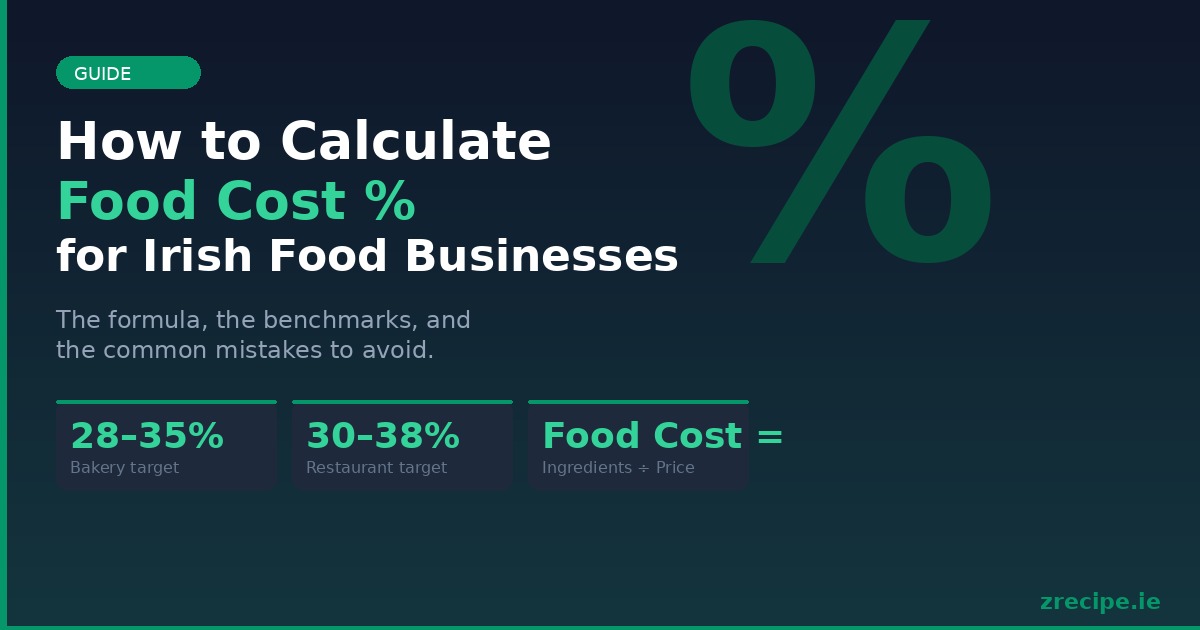
Food cost percentage is the proportion of a dish's selling price that goes toward the raw ingredients used to make it. The formula is simple:
Food Cost % = (Cost of ingredients ÷ Selling price) × 100
So if a slice of cake costs you €1.20 in ingredients and you sell it for €4.00, your food cost is 30% — meaning 70% of that €4.00 is left to cover labour, rent, overheads, VAT and profit.
What's a good food cost % for bakeries and cafés in Ireland?
Most Irish bakeries and cafés target a food cost of 28–35%. Restaurants with more labour-intensive plates often run slightly higher, closer to 30–38%, while high-volume bakery items (bread, traybakes) can sit lower, around 20–28%, because ingredient cost is low relative to price. There's no single "correct" number — it depends on your labour costs, rent, and how much hands-on preparation each item needs. The point of tracking it isn't to hit a magic figure; it's to know your number for every recipe, so you can spot the ones quietly dragging your margin down.
How to calculate it per recipe
Do this for every item on your menu, not just a few:
- List every ingredient in the recipe with its exact quantity.
- Price each ingredient at its current cost per unit — not what you paid six months ago.
- Add up the total ingredient cost for the recipe.
- Divide by the number of portions the recipe yields to get cost per portion.
- Divide cost per portion by your selling price, then multiply by 100.
Repeat this every time a supplier price changes. A recipe that was 28% in January can drift to 34% by June if flour, butter or dairy prices move and nobody re-checks it.
Common mistakes
- Not including labour. Ingredient cost alone doesn't tell you if a dish is profitable — a labour-intensive item can look cheap on paper and still lose money.
- Ignoring waste and yield. Trim loss, peeling, reduction during cooking — the price you pay per kilo isn't the cost per usable kilo.
- Forgetting VAT. Your selling price includes VAT, but your food cost calculation should be based on the net (VAT-excl.) selling price, or your percentage will look artificially healthy. Our free VAT calculator makes it quick to check net vs gross Irish VAT rates.
- Pricing from memory. Ingredient prices change constantly. A price that was accurate when you built the recipe six months ago is a guess today.
How ZRecipe automates this
Manually recalculating food cost across a full menu every time a supplier invoice changes isn't realistic for most kitchens — so it rarely happens, and margins drift unnoticed. ZRecipe reads your supplier invoices, updates ingredient prices automatically, and recalculates the true cost and margin of every recipe that uses them — instantly, across your whole catalogue, including labour, waste and VAT. You always know exactly which recipes are healthy and which ones need a price review, without opening a spreadsheet.
Enjoyed this guide?
Try ZRecipe free for 14 days
Import invoices, track ingredient prices, and see the real cost and margin of every recipe — automatically.
Start free trialRelated posts
EU Allergen Labelling Requirements for Irish Food Businesses in 2026
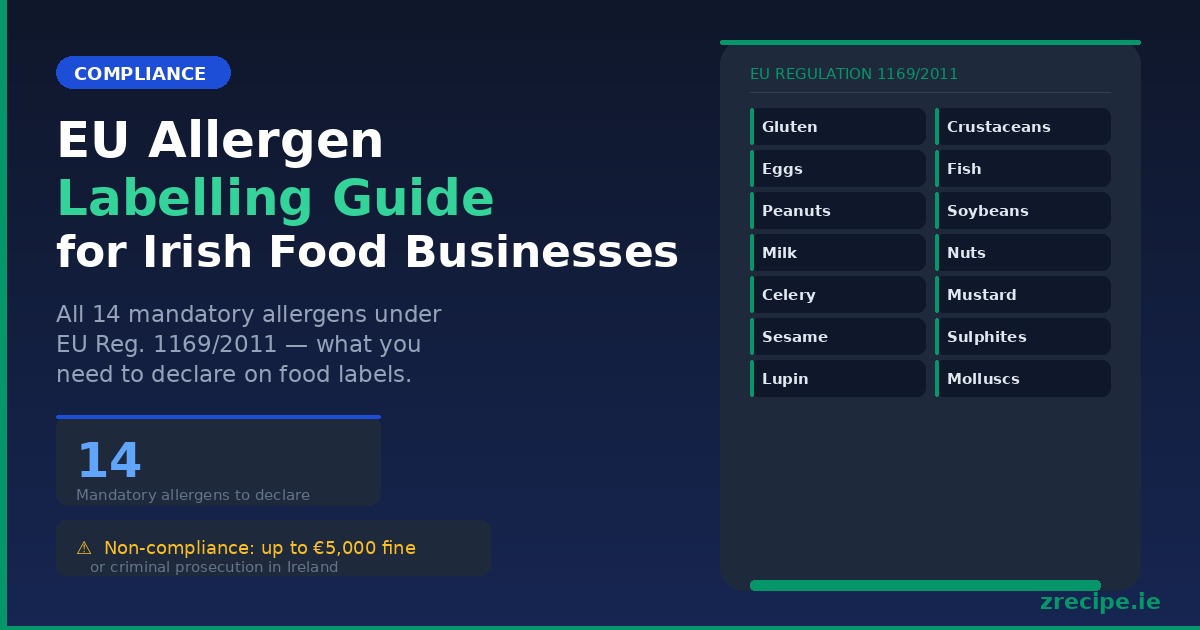
EU Regulation 1169/2011 requires all 14 major allergens to be declared on food labels. Here's what Irish bakeries, cafés and restaurants need to know to stay compliant.